
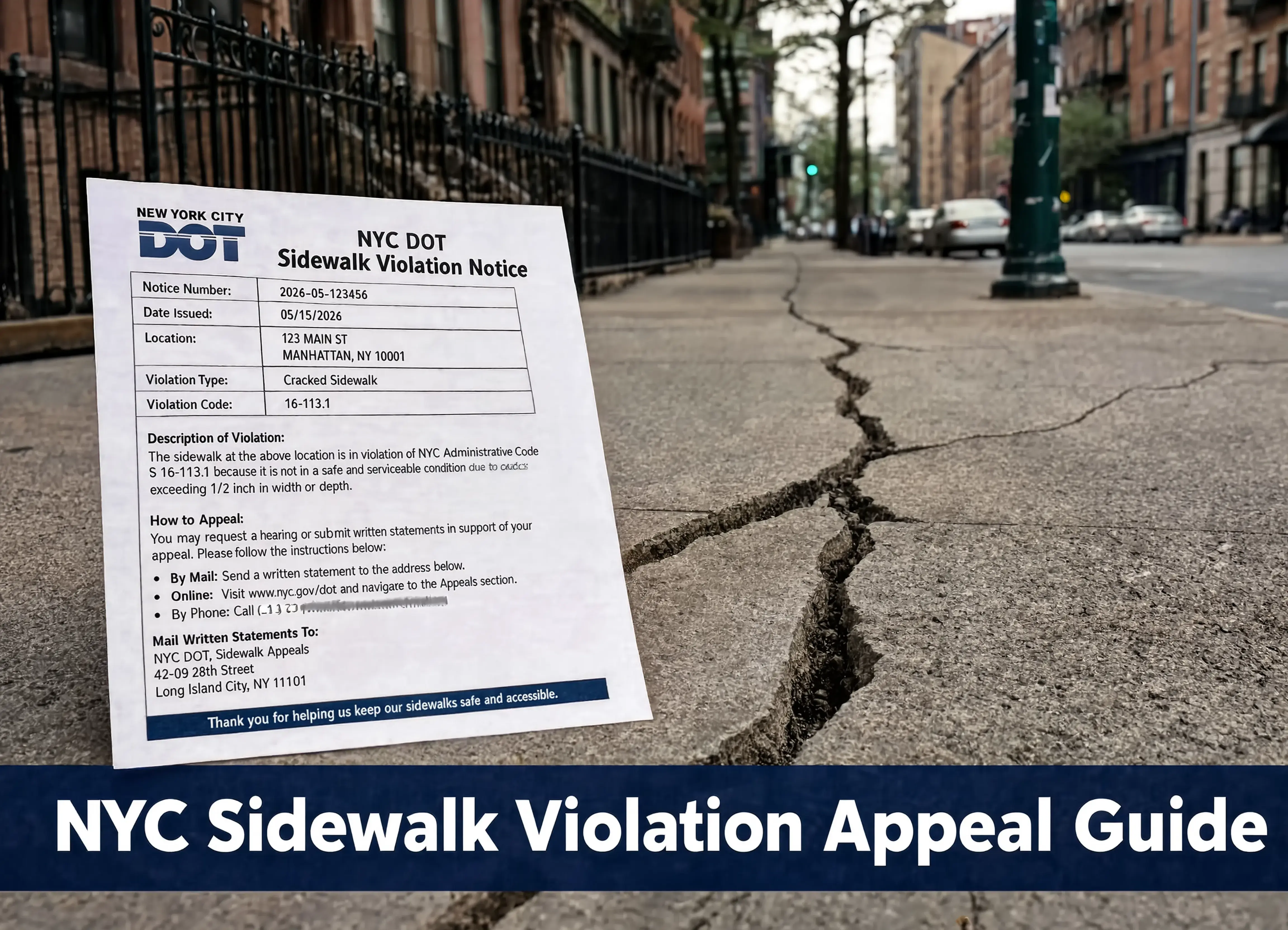
Getting a sidewalk violation notice in the mail is never a fun surprise. But before you assume you owe money or start scheduling repairs, take a breath. If the damage listed on your notice doesn't match what's actually on your property, or the inspection details just don't add up, you have every right to push back. Knowing how to appeal NYC sidewalk violation notices the right way can save you from paying for repairs you don't need, protect you from a lien down the road, and keep your property record clean.
Here's the complete process, mapped out so you're not left guessing at any point.
Why Sidewalk Violations Sometimes Get It Wrong
The NYC Department of Transportation inspects sidewalks across the five boroughs and issues violations based on what a field inspector observes and records on a Preliminary Inspection Report, often called a PIR. That report becomes the basis for your Notice of Violation.
The problem is that inspectors cover a lot of ground, and mistakes happen. Maybe the reported defect is actually on your neighbor's section of sidewalk instead of yours. Maybe the crack or trip hazard listed doesn't exist anymore because you already had it repaired. Maybe the inspector measured a joint offset incorrectly, or the violation references a section of sidewalk that isn't even part of your legal frontage.
Whatever the reason, if a sidewalk violation notice with wrong information has landed in your mailbox, you're not stuck with it. The city has a formal appeal process built specifically for situations like this, and it's laid out under NYC Administrative Code 19-152, the same code section that governs sidewalk maintenance responsibility for property owners in the first place. If you want a deeper breakdown of what property owners are actually responsible for under this code, our NYC sidewalk repair FAQs page will help you understand most common questions that often come to your mind and leave you guessing.
How to Appeal NYC Sidewalk Violation Notices: The Basics
Here's the short version before we get into the details. If you believe the defects marked on your PIR don't exist on your sidewalk, you can formally contest DOT sidewalk violation findings through an appeal. The appeal has to be submitted within 75 days from the date you received your Sidewalk Violation Notice, so timing matters more than almost anything else in this process.
Once DOT gets your appeal, they'll schedule a reinspection within 180 days. A different inspector, one who has never seen the original PIR, will come take a fresh look at your sidewalk. Their findings are considered final, and you'll get the results by mail.
That's the entire framework. Now let's break down each piece so you know exactly what to do.
The 75-Day Deadline Isn't Flexible
This is the part property owners get tripped up on most often. The sidewalk violation 75-day window starts from the date you actually received your notice, not from the date the violation was issued internally by DOT.
By law, DOT sends these notices by certified mail. If the mail can't be delivered for whatever reason, the notice gets posted directly on the property instead. Your official notice date, the one that starts your 75-day clock, is whichever comes first: the date on your certified mail receipt or the date the notice was physically posted.
Miss this window and you lose your ability to formally contest the violation through this channel. So if you're planning on how to fight NYC sidewalk violation issues, the very first thing to do is check your notice date and count backward from there. Don't wait until you've gathered every piece of evidence before starting your appeal. File it, then keep building your case if needed.
What You'll Need Before You Start
Before you sit down to file your appeal, have a few things ready:
-
Your sidewalk violation number, which is typically 4 to 6 digits (something like 1432 or 31221)
-
Current photos of your sidewalk showing the actual condition
-
Any records of recent repairs or maintenance you've had done
-
Documentation showing the damage isn't your responsibility, if that applies to your situation
The more supporting evidence you attach, the stronger your appeal looks to the reinspecting inspector. A photo showing a smooth, repaired sidewalk next to a violation citing a trip hazard tells its own story.
If your violation was actually issued because of real damage and you've already had the repair done, this appeal process isn't the right path for you. Instead, you'll want to follow the standard closeout procedure, which we have covered in detail in our step-by-step guide to dismissing a sidewalk violation after repairs.
How to Fill Out the DOT Sidewalk Violation Appeal Form
DOT handles sidewalk violation reinspection requests through the NYC 311 portal. Here's exactly what to expect when you open the Violation Appeal Form, broken down section by section so you're not stuck wondering what to enter where.
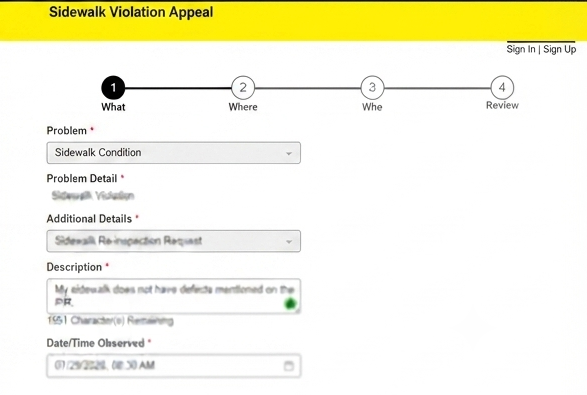
Step 1: Problem Details
When the form loads, you'll first select your problem type. Choose Sidewalk Condition as the general category, then select Sidewalk Violation under Problem Detail.
Under Additional Details, you'll pick Sidewalk Re-inspection Request. This tells DOT you're not reporting a new issue, you're contesting an existing violation.
Next comes the Description box. You get 1945 characters here, so use the space wisely. Explain clearly why you believe the violation is incorrect. For example, state whether the defect described in the PIR doesn't exist, has already been repaired, or is located on a section of sidewalk that isn't part of your property. Be factual and specific rather than emotional. Something like "The PIR cites a raised joint offset at the northeast corner of the property frontage, but this section was fully replaced in [month/year] and no defect currently exists" gives the reinspecting officer a clear, checkable claim.
You'll also see a Date/Time Observed field. Enter the date you're submitting the request, or the date you last checked the sidewalk condition yourself.
Finally, you'll be asked if this is a recurring problem. For a first-time appeal, select No/Unknown. Then select the option confirming your request type before moving to the next step.
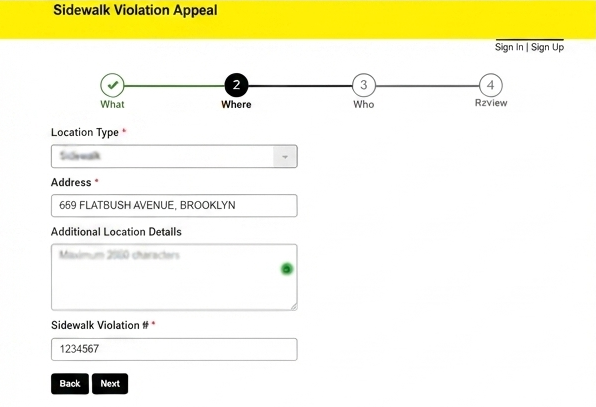
Step 2: Location Details
Here you'll confirm the Location Type as Sidewalk, then enter your property Address exactly as it appears on your violation notice. Small discrepancies in address formatting can slow down processing, so match it to your notice precisely, including apartment or unit numbers if applicable.
The Additional Location Details box gives you 2000 characters. Use this space to specify exactly where on your property frontage the disputed defect is marked, for example, "defect marked along the west side of the sidewalk frontage, approximately 10 feet from the building entrance."
Then comes the field that trips people up if they don't have it ready beforehand: Sidewalk Violation #. This is your violation number from your Notice of Violation, 4 to 6 digits long. Without this number, DOT can't match your reinspection request to the correct case file, so double check it against your notice before submitting.
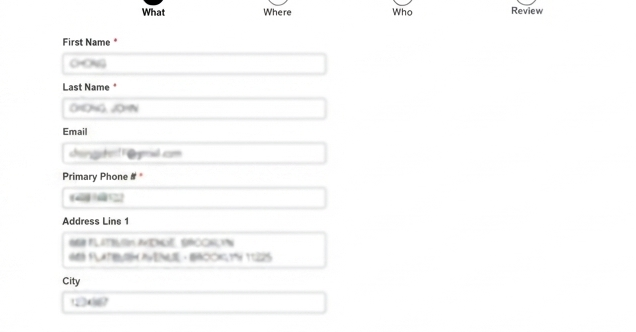
Step 3: Your Contact Information
This section is straightforward. You'll fill in:
-
First Name
-
Last Name
-
Email
-
Primary Phone Number
-
Address Line 1
-
Address Line 2 (if applicable)
-
City
-
State
-
Zip Code
Make sure the contact information you enter here is current, since this is where DOT will send updates and the final reinspection results.
Step 4: Review and Submit
Before submitting, go back through every field. Confirm your violation number is correct, your description clearly explains the discrepancy, and your contact details are accurate. A rejected or delayed appeal often comes down to a small error here, like a transposed violation number or a mismatched address.
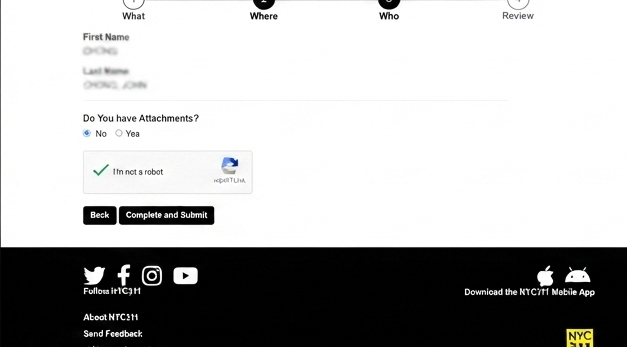
Once everything checks out, complete the captcha verification and hit Complete and Submit. You should receive a confirmation that your request has been received.
What Happens After You Submit Your Appeal
Once your sidewalk violation appeal is in the system, DOT will schedule a reinspection within 180 days of your request. This next inspection is handled by a completely different inspector than the one who issued your original violation, and importantly, this new inspector doesn't have access to the original PIR. That's intentional. It keeps the review fair and prevents the second inspection from being influenced by the first one's findings.
The reinspecting officer will independently assess your sidewalk and determine whether the originally cited defect actually exists. Once that reinspection is complete, the results are considered final. You'll receive the outcome by mail, and it will state clearly whether your violation is upheld or dismissed.
If the appeal is successful, your violation is cleared from your record, which means you avoid any associated fines and reduce the risk of a future lien tied to unresolved sidewalk violations. But if your reinspection doesn't go your way, or the defect turns out to be real, the fastest path forward is getting it repaired and removed properly. Our team handles sidewalk violations removal across NYC, from the repair work itself to getting the violation cleared from your DOT record.
What Delaying Your Appeal Could Cost You
It's tempting to set a violation notice aside, especially if you're busy or unsure where to start. But the sidewalk violation appeal process is time-sensitive by design. Waiting too long past your 75 day window closes the door on this option entirely, and at that point your only real path forward is completing the repair and going through the standard dismissal process instead.
Filing promptly also protects you from something bigger: unresolved sidewalk violations in NYC can eventually turn into liens against your property if they go unaddressed. Contesting an inaccurate violation quickly, correctly, and with solid documentation is the most direct way to avoid that outcome altogether.
Frequently Asked Questions
How long do I have to appeal an NYC sidewalk violation?
You have 75 days from the date you received your Sidewalk Violation Notice to submit your appeal. That date is based on either your certified mail receipt or the date the notice was posted on your property, whichever happened first.
What if I don't have my sidewalk violation number?
Your violation number appears directly on your Notice of Violation and is typically 4 to 6 digits long. If you've misplaced your notice, check your DOT correspondence or contact 311 for assistance locating your case number before submitting your appeal.
Will the same inspector who issued my violation handle my reinspection?
No. DOT assigns a different inspector to your reinspection, and that inspector does not have access to the original Preliminary Inspection Report. This keeps the review independent and unbiased.
How long does DOT take to schedule a reinspection after I appeal?
DOT is required to schedule your reinspection within 180 days of receiving your appeal request.
What happens if my appeal is denied?