
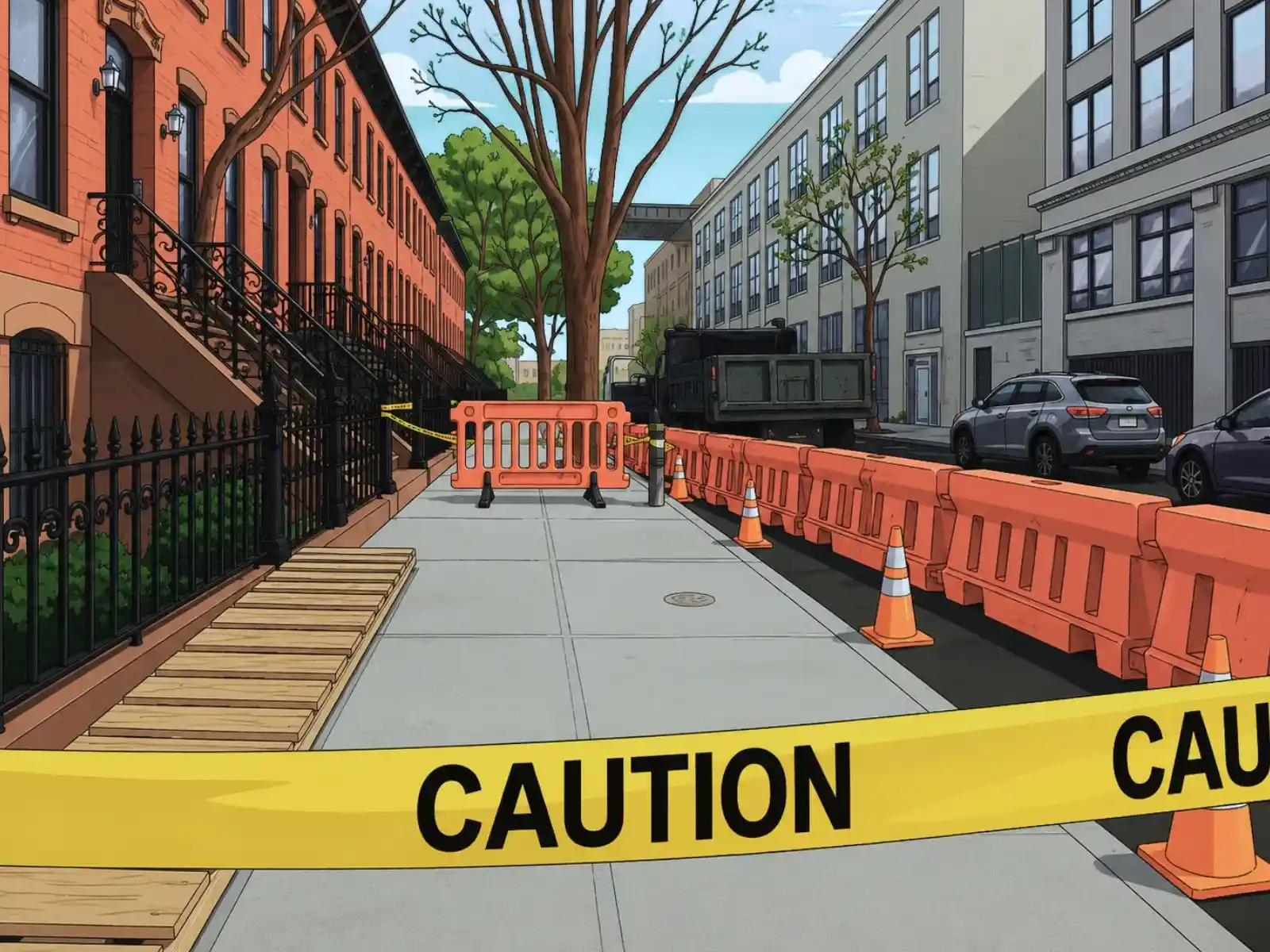
Concrete sidewalk repair in NYC is perhaps the most questioned home maintenance issue for good reason. Between the DOT inspections, the DCWP licensing requirements, and the threat of a lien on your property, we can understand all the concerns. To help, we've compiled answers to the questions we hear most often from homeowners and business owners across New York City. As trusted sidewalk contractors in NYC, we've guided 3000+ property owners through every stage of the process, from understanding a Notice of Violation to completing DOT-compliant sidewalk repairs.
This guide covers everything you need to know, including who is responsible for sidewalk repairs, who may be liable for trip-and-fall accidents, how long sidewalk permits remain valid, and what to do if a city tree has damaged your sidewalk.
Who Is Responsible for Sidewalk Repair in NYC?
Under Administrative Code §19-152, the owner of the property adjacent to a sidewalk is legally on the hook for keeping it in good repair. This covers residential, mixed-use, and commercial properties alike and applies to routine maintenance, repairs, replacement, and even new installation. If a section of sidewalk cracks, heaves, or becomes a trip hazard, it's the owner's job to fix it, not the city's. Administrative Code §7-210 goes a step further and makes owners liable if a pedestrian is injured because of a defective sidewalk.
The one carve-out: If sidewalk damage is caused solely by City-owned tree roots in front of an owner-occupied 1-, 2-, or 3-family residential property (with no commercial use), NYC generally does not issue a Sidewalk Violation or place a lien against the property owner under the City's current policy. In these situations, the City typically assumes responsibility for repairing the tree-root-related damage. However, this policy affects enforcement, not civil liability. Property owners may still face legal liability if someone is injured because of an unsafe sidewalk, even when no DOT violation has been issued.
What Happens When You Ignore Sidewalk Maintenance?
Letting sidewalk problems sit unaddressed carries real legal and financial risk. If the NYC Department of Transportation (DOT) identifies hazardous sidewalk defects, it issues a violation notice, giving the property owner 75 days to complete the required repairs. If the violation isn't resolved within that timeframe, the city may perform the repairs and place a lien on the property to recover the costs. That lien can complicate or delay the sale or refinancing of the property until it is paid off.
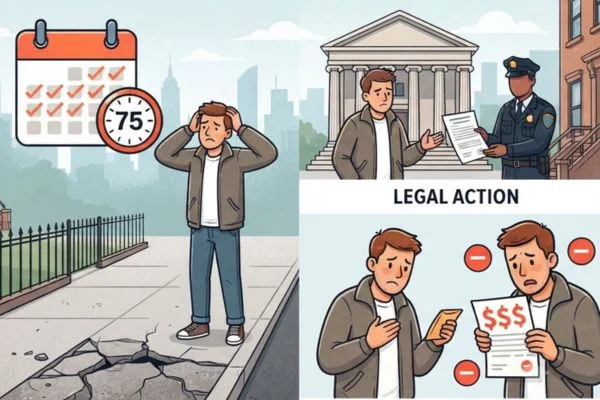
Beyond that, an injured pedestrian can bring a civil lawsuit directly against the owner under §7-210, and those cases can run into the thousands of dollars, particularly for commercial properties or sidewalks with heavy foot traffic. Owners can also be fined separately for failing to clear snow and ice within four hours of a snowfall ending. The one flip side: if the defective sidewalk sits in front of an owner-occupied 1-, 2-, or 3-family home, liability for an injury may fall on the city instead of the owner.
What Are the Most Common Sidewalk Defects That Lead to Violations?
DOT inspectors are looking for a specific list of conditions, and any of the following can result in a violation:
- Missing sidewalk flags (panels), or flags that were never installed
- Severe cracking or breakage running from joint to joint
- Cracks ¼ inch or wider with loose or removable material
- Height differences of ½ inch or more between adjacent flags
- Surface defects at least 1 inch wide and 1 inch deep in any direction
- Improper slope that causes water to pool rather than drain toward the curb
- Cross slopes steeper than DOT's allowable limit
- Utility covers or hardware sitting more than ½ inch above or below the sidewalk surface
- Cellar doors that flex more than 1 inch under weight
- Damaged, slippery, or otherwise hazardous hardware
- Structural cracking spanning joint to joint near already-damaged flags
- Work that doesn't meet DOT's design, material, or construction standards
- Surface patches that don't resolve the underlying defect
- Non-approved materials, such as asphalt used in place of concrete
- Partial or improperly executed patch repairs
What Happens If I Ignore a Sidewalk Violation Notice?
Ignoring a Notice of Violation doesn't make the problem go away, but it escalates the problem. Property owners get 75 days to correct a standard violation (or just 10 days if DOT flags the defect as an immediate hazard). If that window passes without action, DOT can step in, perform the repair itself through a contractor, and then bill the property owner for the full cost plus an administrative surcharge that can add up to 20% on top. If that bill goes unpaid for about 90 days, it doesn't just sit as a debt; it converts into a lien against the property, which shows up in title searches and has to be satisfied before the home can be refinanced or sold cleanly. In short, delay converts a manageable contractor job into a forced, city-priced repair with legal strings attached.
Do I Need a Permit to Fix My Sidewalk in NYC?
In almost every case, yes. The NYC Department of Transportation requires a Sidewalk Construction/Repair Permit before any concrete work begins on a public sidewalk, whether the job is voluntary maintenance or being done to clear a violation. The permit ensures the work meets DOT's engineering specifications, for example, proper slab thickness, correct slope for drainage, and ADA-compliant grading where applicable. There's a narrow exception for very minor cosmetic touch-ups that don't involve removing or replacing concrete (think small surface patching under roughly 25 sq. ft. or a single slab), but any real repair or violation removal like grinding a trip hazard, replacing a cracked flag, or redoing a full section needs a permit pulled by a licensed and city-authorized contractor. Skipping this step isn't just a compliance risk, but unpermitted work can lead to failing DOT's final inspection and city orders to redo the work entirely, meaning you pay for the repair twice.
How Long Does a Sidewalk Repair Permit Take in NYC?
Once a complete application is submitted to DOT, either online or by mail, processing typically takes about 3 to 4 business days. That said, "processing time" and "total time before work starts" aren't the same thing. Applications with missing information, an incomplete sketch of the work area, or an unnotarized Affidavit of Ownership (for mailed applications) can bounce back and reset the clock. Once approved, the permit itself is valid for a 30-day work window, giving the contractor a defined period to complete the job. Property owners working against a violation deadline should build in time not just for the permit itself but also for scheduling the contractor and completing the physical work within that 75-day compliance period.
Can I Fix My Own Sidewalk, or Do I Need a Contractor?
Technically, sidewalk permits can only be pulled by someone holding an active DOT Permittee ID, and most individual homeowners don't have one. In practice, that means the vast majority of sidewalk repairs in NYC have to go through a licensed, DOT-registered contractor who can pull the permit, perform compliant work, and manage the required inspections. There's also a separate consumer-protection layer: any home improvement job over $200 legally requires the contractor to hold a Home Improvement Contractor License issued by NYC's Department of Consumer and Worker Protection (DCWP). So while a homeowner might be tempted to DIY a small patch, anything beyond the most minor cosmetic fix and certainly anything tied to a violation needs a licensed professional; both to meet DOT's permit requirements and to pass the final inspection.
How to Look Up a Sidewalk Violation on My Property?
The most direct way to check your NYC DOT sidewalk violation status is to call 311, which can pull up DOT's records for your address and tell you whether a Notice of Violation is on file, when it was issued, and what the compliance deadline is. NYC's online 311 portal offers a self-service version of the same lookup. If you're buying a property or need to confirm that a previous owner's repair was actually authorized, you can also request a "permit of record" directly from DOT. This document proves whether specific sidewalk work was permitted and inspected, which matters for closing out old liens or resolving title issues during a sale. Another reliable source is the NYC DOT Sidewalk Management Database. The city regularly updates this database with information about properties that have active sidewalk violations, including the violation ID, issue date, compliance deadline, and a description of the sidewalk defect. To check whether your property has a violation, simply enter the property address in the database search bar and review the listed records.
How Do I Report a Sidewalk Issue in NYC?
Any sidewalk defect can be reported through NYC 311 or the online complaint form on the DOT website; just include the exact street address. This applies whether the sidewalk sits in front of a residential or commercial property, a city-owned building, a bridge underpass, or a traffic median or pedestrian island. (Note: a residential building with even one ground-floor store or office counts as commercial for these purposes.)
For city-owned properties like public housing, parks, hospitals, schools, libraries, shelters, city agency offices, and medians, the same 311 form applies. DOT will verify ownership, inspect the site, and loop in the responsible agency if repairs are needed.
For residential and commercial properties, DOT inspects after a complaint comes in and, if a defect is confirmed, issues the owner a Notice of Violation with a compliance deadline, typically 75 days. Worth noting: DOT does not issue violation notices to owners of 1-, 2-, or 3-family residential properties. For those properties, if tree roots are the cause, the path forward is usually a request through the Trees and Sidewalk Repair Program rather than a standard violation.
How Does the DOT Sidewalk Inspection Process Work?
Inspections are usually triggered by a 311 complaint, a routine survey, or nearby construction activity. A DOT inspector examines each individual sidewalk panel ("flag") for cracking, unevenness, missing sections, or anything else that could pose a hazard. If defects turn up, the inspector issues a Notice of Violation, which is mailed to the property owner and also filed with the County Clerk, becoming part of the property's official record. The notice includes a description of the defects, photos taken during the inspection, and a compliance deadline, usually 75 days, though a genuinely hazardous condition can trigger a 10-day emergency repair notice instead. It's worth understanding these are civil, not criminal violations, since there's no immediate fine attached, but ignoring one can lead to the city performing the repair and billing the owner.
How to Deal With a Sidewalk Violation Notice?
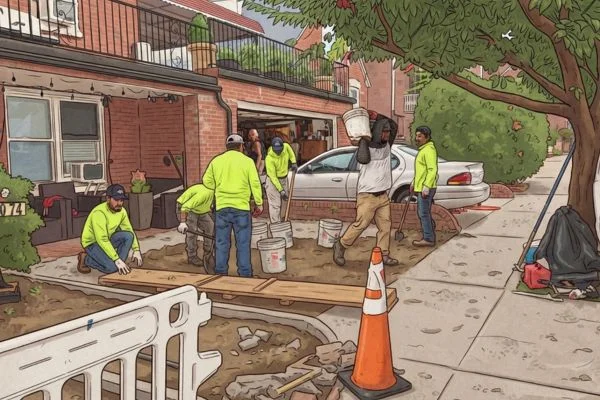
Once a notice arrives, four steps get you to resolution:
Step 1: Hire a licensed contractor. Only contractors licensed by DOT and by the Department of Consumer and Worker Protection (DCWP) can legally perform sidewalk repairs in NYC. Any job over $200 requires a valid DCWP Home Improvement Contractor License. Before hiring, verify status by calling 311 or checking the Business Background Check page, which also surfaces any complaint history.
Step 2: Pull a sidewalk repair permit. A permit is required for sidewalk construction or repair, temporary structures like canopies, furniture placement, or anything that blocks pedestrian access. Skipping this step risks fines, delays, or having finished work rejected outright. Since only licensed contractors can obtain the permit, your contractor typically files it on your behalf. The fee is $70 and covers up to 300 linear feet of one property; corner properties needing work on two sides require two separate permits with a separate fee. Mail-in applications need the completed form, a notarized Affidavit of Ownership, a certified check for $70 payable to NYC DOT, and a stamped, self-addressed envelope sent to the following address:
NYC Department of Transportation,
Permit Management & Construction Control,
Permit by Mail,
55 Water Street, Concourse Level, New York, NY 10041.
Step 3: Complete the repairs. This covers fixing cracks, re-leveling uneven slabs, replacing broken sections, or filling in missing ones. Sealed, 1-inch-thick expansion joints are required at every property line, where the sidewalk meets the curb, and every 8 to 15 feet along the run. Any pedestrian ramp work needs detectable warning surfaces such as the textured yellow panels for visually impaired pedestrians.
Step 4: Request reinspection. Once the work is done, call 311 to schedule a violation dismissal inspection. You must meet the violation dismissal criteria to pass the inspection. Have your permit number, property address, block and lot number, violation notice number, and contact information ready. Make sure the site is clear of cars, materials, or other obstructions before the inspector arrives. If everything meets code, the violation is dismissed, and any lien is cleared from the property record by the County Clerk's office.
What to Do If I Think My Sidewalk Violation Notice Is Wrong?
If the defects described in your Preliminary Inspection Report or Violation Notice don't actually match what's happening on your sidewalk, you have every right to push back. Just don't sit on it: you've got a 75-day window from the date you received the notice to file your appeal, so it's worth handling sooner rather than later.
One detail that trips people up: how that 75-day clock actually starts. The city is required to deliver your Notice of Violation by certified mail, but if that delivery doesn't go through, they'll post the notice right on your property instead. Either way, the official countdown begins on whichever date applies, the one on your certified mail receipt, or the date it was physically posted.
Once your appeal is in, DOT takes it from there. They'll schedule a fresh inspection within 180 days, and here's the part that should put your mind at ease: it's handled by a completely different inspector, one who won't even see the original report. That's built-in fairness, plain and simple. Whatever this second inspection turns up is the final word, and you'll get the results by mail.
What If the Violation Notice Was Sent to the Wrong Property Owner?
This can happen when city ownership records are outdated. If you've received a notice for a property you no longer own or never did, you'll need to mail a written correction request, along with proof of the ownership change (a sale deed or updated tax record works), to the following address:
NYC Department of Finance,
Correspondence Unit,
66 John Street, 3rd Floor,
New York, NY 10038.
What If a City-Owned Tree Damaged My Sidewalk?
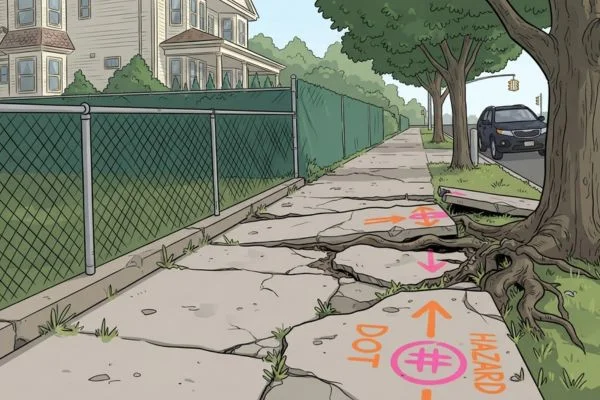
You may be eligible for free repair if two conditions are both true: you own and live in a 1-, 2-, or 3-family home, and the damage is caused solely by tree roots. If so, the NYC Parks Department's Trees and Sidewalk Repair Program may cover it. Not every eligible property is treated equally, though. Parks weighs damage severity, pedestrian traffic volume, and the tree's condition when deciding who gets addressed first. After an inspection, your property is scored from 1 to 100 (100 being most severe); lower scores are less likely to move forward quickly, and some sites end up on a waitlist or deferred due to funding constraints. If your property doesn't make the cut, you can request reassessment after three years, especially if conditions have worsened.
To start the process, contact NYC Parks and request an inspection. If they confirm tree roots are the cause, they'll either document the issue directly or coordinate with DOT to plan the repair, and qualifying properties get added to the repair list. The catch is timing; even urgent cases can take three years or more to actually get fixed, which is a long wait if you're trying to sell or worried about someone getting hurt in the meantime. Many owners in this position choose to hire a licensed contractor and pay privately, then pursue reimbursement afterward.
How Do I Get Reimbursed for Sidewalk Repairs I Paid for Myself?
If you paid out of pocket to fix tree-root damage that should have qualified for the city's program, you may be able to recover the cost through the NYC Comptroller's Office. You'll need:
- Before-and-after photos of the sidewalk
- A valid Tree Work Permit from NYC Parks
- A Sidewalk Construction Permit from DOT
- Any design recommendations issued by Parks
- Receipts, invoices, and proof of payment from your contractor
Keep everything clearly dated and organized. It directly affects how smoothly the claim moves. You have 90 days from the date the repair work is completed to file.
What Permits Do I Need Before Repairing a Sidewalk Near a City Tree?
Any construction, excavation, pruning, or removal within 50 feet of a city-owned street tree requires a Tree Work Permit from NYC Parks to ensure the tree is protected during construction. A Sidewalk Construction Permit from the NYC Department of Transportation (DOT) is also required to authorize the sidewalk work and ensure it meets city standards. Depending on the location and scope, other city agencies or utility companies, for instance, may require additional permits. Parks inspects the tree as part of reviewing your application; once approved, the tree work permit comes with specific instructions, including the sidewalk repair method being used for that specific damage around the tree, and stays valid for 90 days. After the work wraps up, NYC Parks conducts a final inspection to confirm the job was done properly and the tree is still healthy before signing off. One exception: replacing a single slab (roughly 5x5 feet) doesn't require a permit.
What to Do If Someone Else Damaged My Sidewalk?
Sidewalk damage isn't always the owner's fault. If a contractor or utility company working nearby caused the damage, they're legally required under their permit conditions to restore it. If they don't, you have options:
Step 1: Document everything. Dated photos, notes on when you noticed the damage, and any related permits or communications about nearby construction all strengthen your case.
Step 2: Contact the responsible company directly. Ask them to handle the repair. If they refuse, escalate to a formal claim with their legal or claims department.
Step 3: Check for active work permits. If you're not sure who's responsible, call 311 or the city online portal to check for active street or sidewalk construction permits at your location. If that doesn't clear things up, you can request a formal permit search (a small fee may apply) through the following:
NYC Department of Transportation,
Office of Litigation Services,
Freedom of Information Law Unit (FOIL),
55 Water Street, 6th Floor,
New York, NY 10041.
If the damage happened during a nearby public project, for example, water main work or street reconstruction, and it resulted from the contractor's negligence, they're required to fix it at no cost to you. Report it by calling 311 and asking for the Department of Design and Construction (DDC) Services and Projects or by contacting your local DDC Borough Office directly. If you intend to file a formal damage claim against the city, you have 90 days from the date of the incident to do so.
What to Expect When the City Starts Repair Work on My Sidewalk?
Miss the 75-day window on a Notice of Sidewalk Violation, and the decision stops being yours to make. At that point, NYC DOT is cleared to either handle the repair directly or bring in a contractor to get it done on your behalf.
Nothing starts without a heads-up. You'll get a formal notice first. From there, the process unfolds in a set order:
- A city representative comes out to photograph the sidewalk as it currently stands
- They flag which specific panels need replacing
- The city's contractor moves in to complete the work
Once it's wrapped up, you'll get confirmation that the violation has been officially cleared from the County Clerk's Office records.
Once the repair's done, the bill comes through the Department of Finance, and it's not just the repair cost. DOF tacks on an administrative fee of up to 20%. You've got 90 days to pay it off. Let that deadline pass, and the balance turns into a lien on your property, treated much like unpaid property taxes, which means it can hold up a home sale until it's cleared. After 90 days, interest starts accruing too, calculated at the current property tax rate.
Does the City offer a Payment Plan for Sidewalk Repair Cost?
Yes, the City offers a payment plan for clearing repair charges. A DOF bill for city sidewalk repair work doesn't have to be paid in a lump sum. You can request a payment plan instead, as long as you check every one of these boxes:
- Your property has 1 to 6 residential units, or is assessed at $30,000 or less
- Your bill lands somewhere between $250 and $5,000
- You submit your request within a year of the charge showing up on your property tax record
To get started, download and complete the payment plan application and send it to the Department of Finance. If you'd rather talk it through, the DOF Business Center can help, or call 311 and specifically ask about the Sidewalk Repair Payment Plan.
Can I Challenge City-Completed Sidewalk Repairs?
Yes. If you have concerns about the quality of the work, believe the repairs exceeded what was necessary, or think the charges were calculated incorrectly, you can formally challenge them through the NYC Department of Design and Construction (DDC). However, you must follow this exact order, since skipping a step can void the whole appeal:
- Contact DDC first through 311 or the agency's official website to report your concerns and request a review. Phone calls or walk-in visits alone are generally not considered a formal appeal.
- If the issue remains unresolved, file a Notice of Claim with the NYC Comptroller's Office.
- If you're still dissatisfied, you may take the matter to the Small Claims Assessment Review (SCAR) Part of the New York State Supreme Court, but only after waiting 30 days from the date your Notice of Claim was filed.
- Obtain the required forms from your local County Clerk's Office. These forms are available free of charge.
Following each step in the correct order gives you the best chance of having your dispute reviewed properly.
Will My Homeowners Insurance Cover Sidewalk Repair in Brooklyn?
Generally no, because homeowners insurance is built to cover unexpected damage and liability, not routine maintenance or compliance repairs like fixing a cracked or uneven sidewalk. Preventive or violation-driven sidewalk work is treated the same way a leaky roof or aging plumbing would be: a maintenance responsibility of the owner, not an insurable event. Where insurance can come into play is on the liability side. If someone is injured tripping on your sidewalk in Brooklyn and you're found responsible, your homeowners insurance policy's liability coverage may help with legal costs or a settlement, depending on your policy's terms and any exclusions. Because coverage details vary significantly by carrier and policy, it's worth a quick call to your insurer to understand exactly what is and isn't included before assuming either way.
How Long Does Sidewalk Repair Usually Take?
There's a meaningful difference between the physical construction time and the full process from permit to final sign-off. Actual concrete work such as demolition, forming, pouring, and initial curing is often completed within 1 to 7 days depending on the size of the job. But the complete timeline, including permit processing (roughly 3–4 business days depending on permit type and the agency), scheduling a contractor, completing the work, and getting DOT's final reinspection to close out any violation, commonly stretches to several weeks and can run closer to two months for larger or more complex jobs. Owners working against a violation deadline should plan backward from their compliance date and build in buffer time for each of these stages rather than assuming the work itself is the only variable.
What Should I Look for When Hiring a Sidewalk Repair Contractor?
A few things separate a solid sidewalk contractor from a risky hire: an active Home Improvement Contractor License (verifiable through DCWP or 311), direct experience specifically with DOT sidewalk permits and inspections (not just general concrete or masonry work). A willingness to handle the permit application and final reinspection on your behalf rather than leaving that to the homeowner, and a detailed written estimate that itemizes demolition, materials, and any root-related work separately. It's also worth asking how they handle a failed reinspection because a reputable contractor should stand behind their work and fix compliance issues without charging again. Given how often tree roots complicate NYC sidewalk jobs, contractors with specific experience navigating Parks Department root-pruning permits are a meaningful advantage over general concrete crews.
Can I Get a Sidewalk Lien Removed from My Property?
Yes, though it involves a few sequential steps. First, the underlying repair bill or violation that caused the lien has to be paid or otherwise resolved. Once that's done, the property owner (or their contractor) requests a final dismissal inspection through 311 to confirm the sidewalk now meets DOT standards. After that inspection passes, the city needs to formally acknowledge the lien is satisfied, and that lien satisfaction document then gets filed with the County Clerk's office to clear it from the public record. This last filing step matters; until it's recorded, the lien can still show up in title searches even after the underlying debt is paid, which can complicate refinancing or selling the property. Owners dealing with an older lien from a previous owner may need to pull historical DOT records to confirm what was actually owed before it can be cleared.
Do I Need DOT Approval for Sidewalk Repair in the Bronx?
Yes. The Department of Transportation is the governing agency for all public sidewalk work across NYC, including the Bronx and other boroughs as well. And any repair, whether it's voluntary maintenance or required to resolve a violation, needs to be done under a DOT permit and meet DOT's construction specifications. This includes requirements around concrete thickness, curing time, surface finish, and slope for proper drainage. If the work is tied to a notice of violation, DOT approval isn't optional at all. The process explicitly requires a final reinspection before the violation can be dismissed. Even for non-violation maintenance, skipping DOT approval risks having the work flagged later as non-compliant, which can mean redoing it.
Can Sidewalk Repair Damage My Landscaping or Nearby Plants?
It can, particularly when the repair involves working near a tree bed or pruning roots that have grown into the sidewalk's foundation. Because root systems and nearby plantings can be sensitive to excavation, any sidewalk work happening close to a city-owned tree requires a separate Tree Work Permit from the NYC Parks Department, specifically intended to protect the tree during construction, for example, by limiting how much of the root system can be cut (commonly capped around 25% of the root mass in a given area) and specifying safe digging practices. Homeowners with private landscaping adjacent to the work zone should flag those plantings to their contractor ahead of time, since protecting them isn't automatically part of a standard sidewalk repair scope unless it's discussed upfront.
How Often Should I Inspect My Sidewalk for Damage?
An annual inspection, ideally done before winter, is a reasonable standard for most NYC property owners. Freeze-thaw cycles are one of the most common accelerants of sidewalk damage. Water gets into small hairline cracks, freezes, expands, and widens the cracks, so catching minor issues in the fall before winter sets in can prevent a small, cheap fix from becoming a major, expensive one. Properties with mature street trees nearby may benefit from more frequent checks, since root growth is a gradual, ongoing process that can shift a previously sound sidewalk over just a year or two. A simple annual walk-through looking for new cracks, lifting edges, or pooling water is usually enough to catch problems while they're still minor.
What Happens If My Sidewalk Repair in Manhattan Fails After Completion?
If a completed repair doesn't pass DOT's reinspection, meaning the work still doesn't meet code, whether due to improper slope, insufficient thickness, or another spec issue, the underlying violation isn't dismissed. And the property owner is still on the hook to bring it into compliance. This is one of the strongest reasons to hire a reputable, experienced contractor: a well-established one will typically correct a failed inspection at no additional charge, since it reflects a shortfall in their original work. Owners should clarify this before hiring and ask directly whether the contractor guarantees their work will pass DOT reinspection and what happens (in writing, ideally) if it doesn't the first time.
What Documents Do I Need to Submit with a Sidewalk Repair Permit?
A complete DOT sidewalk permit application needs basic property information (borough, address, and block/lot details), the total area of sidewalk to be repaired, and a hand-drawn sketch showing the work zone's location and dimensions relative to the property line and curb. If you're submitting by mail rather than applying online, you'll also need a notarized Affidavit of Ownership confirming you're the legal property owner (or an authorized agent), along with the $70 permit fee. Applications missing any of these pieces, especially an unclear work-zone sketch or a missing notarization, are a common cause of processing delays, so double-checking the full document set before submission helps avoid losing time against a violation deadline. You are only eligible to pull required sidewalk permits if you have a valid permittee ID issued by DOT. Otherwise, your contractor will pull these permits on your behalf.
If I trip on an uneven sidewalk, who can I sue?
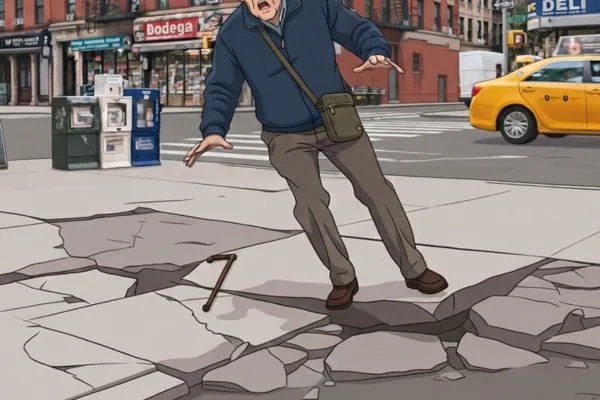
Liability generally follows the same split as maintenance responsibility. Because Administrative Code §7-210 shifted sidewalk liability from the city to property owners for most properties, an injured pedestrian typically has grounds to pursue a claim against the adjacent property owner rather than the city. The major exception is owner-occupied one-, two-, or three-family homes. In those cases, the city can retain liability, but only if it had prior written notice of the specific defect before the injury occurred. Injury claims against a private property owner generally need to be filed within about three years, while claims against the city carry separate and typically much shorter notice deadlines, making the distinction between "who owns it" and "who's liable" genuinely important for anyone considering legal action after a fall.
Is a Sidewalk Considered Public or Private Property?
Most NYC sidewalks sit on a public right-of-way, meaning the government owns that strip of land specifically so pedestrians can use it freely. But your actual property line might legally extend all the way out to the curb, with the sidewalk itself just sitting on top as a kind of public easement. So yes, it's entirely possible to "own" land you don't get to fully control.
Let's break down exactly where your sidewalk falls:
- Public sidewalks. If it's the typical path separating your front yard from the street, chances are it's public, even if your deed technically stretches past it. The city holds that right-of-way, which means anyone can walk there, no permission needed.
- Private sidewalks. Now, if we're talking about a walkway that leads straight up to your front door, cuts through a private driveway, or sits inside a gated community, that's a different story. Those are private property.
- HOA sidewalks. Living somewhere with a homeowners association? The sidewalks running through the community are usually owned by the HOA itself, not the city.
- Business property. The same idea applies to certain commercial stretches, such as a hotel, plaza, or retail center that might actually own the sidewalk fronting their building, even though the public still gets to walk on it.
So here's the part that really catches people off guard: even though the city usually owns the sidewalk, local ordinances typically hand the upkeep responsibility right back to you, the adjacent homeowner. That means shoveling snow, patching cracked concrete, and keeping the edges tidy, it all falls on your shoulders. And if someone trips and gets hurt out there, you could still be held liable, even though you never technically owned the land in the first place.
How Much Does NYC Sidewalk Repair Cost?
Sidewalk repair cost in NYC is generally calculated per square foot, and the final number depends heavily on scope. Small cosmetic jobs like patching a short crack or leveling a minor lip can run as little as $5–$8 per sq. ft. Full slab removal and replacement, which is what most DOT violations actually require, typically lands between $10–$20 per sq. ft. once demolition, disposal, and proper curing are factored in. A small job (around 25 sq. ft. or just 1 slab) often totals $800–$2,500 in a residential area, while a full-frontage replacement on a standard rowhouse lot can run $3,000–$7,000 or more, especially if tree roots have to be addressed first. Corner properties, ADA-compliant curb ramps, and sites with limited truck access typically add cost. Because pricing swings so widely based on square footage, site conditions, and whether root removal is involved, an on-site quote after a thorough inspection is really the only way to get an accurate number, but homeowners should expect anywhere from a few hundred dollars for a patch to several thousand for a full replacement.
Who is Responsible for Curb Repair in NYC?
Curbs are the raised edge separating the street from the sidewalk while serving several safety functions: keeping vehicles off the sidewalk, protecting pedestrians, and supporting proper drainage. Unlike sidewalks themselves, curbs are owned by the city, not the adjacent property owner, and DOT handles their installation, maintenance, and repair.
The reasoning goes back to how NYC's streets are engineered as a whole system. Curbs work together with street grading and catch basins to direct rainwater where it needs to go, and because they're such an integral part of the roadway infrastructure (not just the pedestrian path), the city has kept ownership and upkeep centralized under DOT rather than pushing it onto individual property lines. It also means curb specifications, materials, and replacement schedules are standardized citywide rather than left to whatever an individual owner might choose to install.
Why Choose The Sidewalk Repair NYC for Your Sidewalk Needs?
NYC sidewalk violations come with tight deadlines, layered permit requirements, and real financial exposure if the work is done wrong or the paperwork slips through the cracks. The Sidewalk Repair NYC handles the entire process end-to-end, from confirming your violation and pulling the correct DOT permit to completing code-compliant concrete work and scheduling the final reinspection that gets your violation dismissed.
Our crews work across all boroughs and are experienced with the specific complications that trip up general contractors, like navigating Parks Department root permits when a city tree is involved or documenting work properly for Comptroller reimbursement claims. As an experienced DOT-licensed sidewalk contractor in NYC, we stand behind every repair we complete, and if a reinspection doesn't pass the first time, we return to correct it at no extra cost.
If you've worked with us before and had a good experience, we'd genuinely appreciate it if you'd leave us a Google review. It helps other NYC property owners find a contractor they can trust with their next violation or repair.