
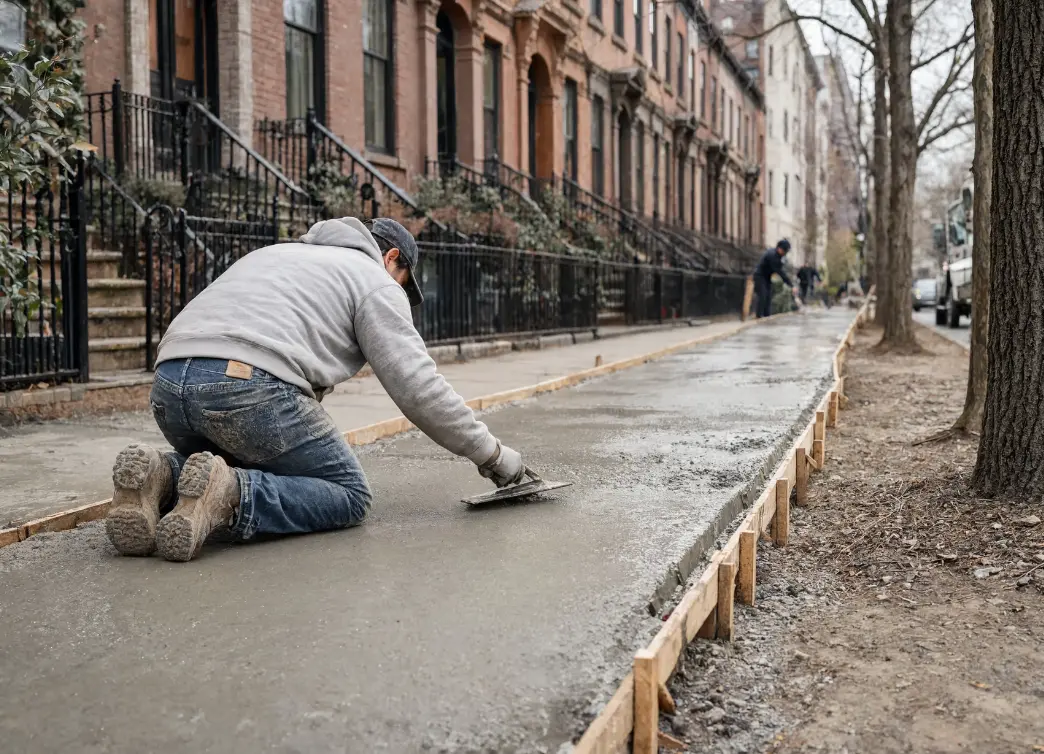
Concrete sidewalk installation in NYC is governed by a detailed set of Department of Transportation rules covering everything from slab thickness and flag size to the exact concrete mix a contractor is allowed to pour. In practice, that means a compliant sidewalk isn't just poured concrete. It is 4 inches thick over a 6-inch base for a typical home, built from 5-foot by 5-foot flags, using concrete that hits at least 4,000 PSI, and finished to meet ADA slope requirements. Get any one of those specs wrong, and the city can issue a violation before the concrete has even finished curing.
If you're a homeowner planning a replacement, a property manager fielding a Notice of Violation, or a contractor bidding on a job, it helps to know exactly what NYC DOT expects before the first flag comes up. Here's a full breakdown of the standards, specs, and sizing rules that govern concrete sidewalk installation across the five boroughs.
What Counts as Concrete Sidewalk Installation in NYC?
Concrete sidewalk installation refers to laying new sidewalk pavement or fully replacing existing pavement in front of a property, following the material, thickness, and structural standards set by NYC DOT's Standard Highway Specifications and the Highway Rules under Title 34 of the Rules of the City of New York. This is different from a small patch repair. Sidewalk construction at this level typically means removing full flags down to the subbase, regrading, and pouring new concrete rather than resurfacing over what's already there.
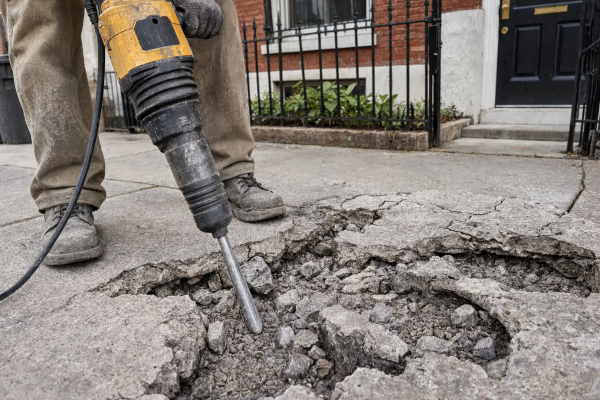
Because the sidewalk itself is technically city property (even though the abutting property owner is legally responsible for maintaining it), any sidewalk concrete work has to follow city specifications regardless of who's paying for it. That applies whether the job is triggered by a DOT violation, a tripping hazard, or a homeowner simply wanting a fresh, even surface.
How Thick Should a Sidewalk Be? NYC's Thickness Requirements
The answer depends entirely on what's sitting on top of it. NYC DOT sets sidewalk thickness requirements based on load: pedestrian-only areas need less concrete than sections that see car and truck traffic.
-
Residential sidewalks: A standard residential sidewalk is built with a single 4-inch course of concrete over a 6-inch compacted foundation.
-
Driveway aprons and corner quadrants: Any section of sidewalk that crosses a driveway or sits on a corner quadrant needs to be 7 inches thick, since it absorbs the weight of turning vehicles.
-
Commercial sidewalks: In areas with heavy vehicular or pedestrian traffic, sidewalk concrete needs to go up to 8 inches, laid over a foundation of ¾-inch broken stone, recycled concrete, gravel, or another fully compacted granular material.
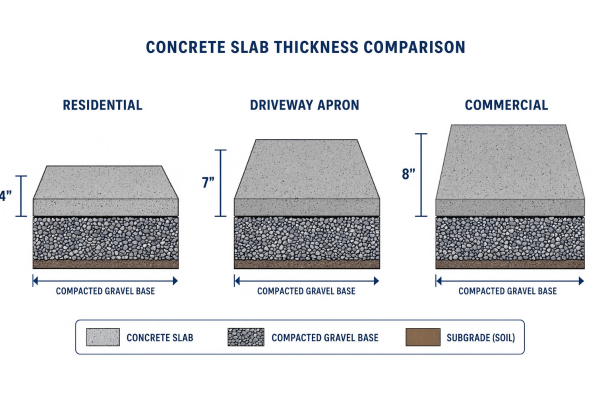
Contractors who pour a residential-grade 4-inch slab across a driveway apron are setting the homeowner up for cracking, settling, and a very likely re-inspection failure. This is one of the more common mistakes cited when a fresh installation still ends up flagged, a topic covered in more detail in our sidewalk repair FAQs for NYC property owners.
What Concrete to Use for Sidewalk Work in NYC
This is where a lot of the confusion comes in, because "concrete" isn't a single product. It is a mix rated by compressive strength. So what kind of concrete for sidewalk installation does the city actually require?
NYC DOT specifications call for concrete rated at a minimum of 4,000 PSI (pounds per square inch), with many contractors pouring in the 4,000–4,500 PSI sidewalk range to build in a safety margin against the freeze-thaw cycles, New York winters put pavement through. Sidewalk concrete at this strength holds up better to salt exposure, vehicle loads at driveway crossings, and the general wear of a dense urban environment than a lighter residential mix would.
For sidewalk pavement restoration and related work, DOT bulletins specify concrete meeting Class B-32 requirements under Section 3.05 of the Standard Highway Specifications, essentially a codified way of saying the mix has to meet that same compressive-strength threshold, along with correct air entrainment for cold-weather durability. So when you're asking what concrete to use for sidewalk installation on a DOT-regulated job, the short version is: nothing under 4,000 PSI, properly cured for 28 days, and matched to Class B-32 where pavement restoration is involved.
Cement sidewalks poured below this spec might look fine on day one, but they're far more likely to spall, crack, or fail early inspection, which then puts the property owner right back in violation territory. If your sidewalk already has a violation attached to it, our page on removing an active sidewalk violation walks through what has to happen before DOT will sign off.
Flag Size in NYC: Why 5×5 Is the Standard
A "flag" is simply one individual slab of poured sidewalk concrete, and NYC DOT rules are specific about how big each one should be. Under the Highway Rules, flags must be 5 feet by 5 feet where feasible. When a building's frontage doesn't divide evenly into 5-foot sections, the flags get adjusted proportionally so each one lands as close to 5 feet as possible, with cross-flag scoring set at a 90-degree angle to the building line and curb.
That flag size in NYC isn't just cosmetic. Standardized 5×5 flags allow DOT inspectors to quickly identify which specific sections of sidewalk have defects, since city rules require full flag replacement rather than partial patching whenever a section shows substantial damage.
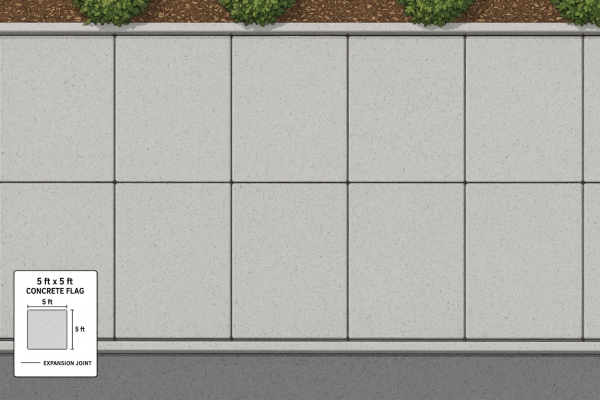
Expansion joints between flags also matter here: they're required at 20-foot intervals, must run the full depth of the sidewalk, and need to be recessed and properly sealed to control cracking as the concrete expands and contracts with temperature.
ADA Compliance: The Accessibility Side of Sidewalk Construction
Every new sidewalk installation also has to clear federal ADA accessibility standards on top of DOT's material specs. That means:
-
A minimum sidewalk width of 36 inches (3 feet)
-
A maximum running slope of 1:48, or no steeper than roughly 2%
-
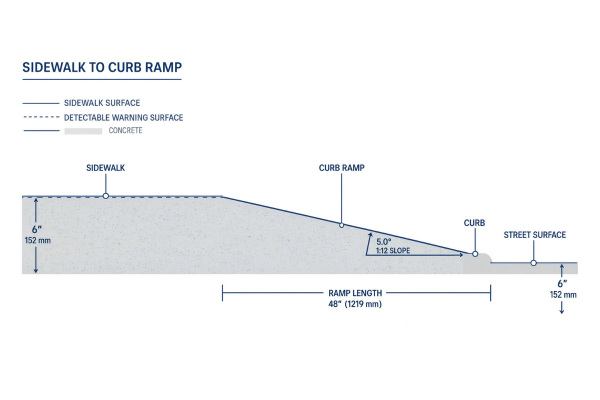
Curb ramps sloped no more than 1:12
These numbers matter more than they might seem. A sidewalk that's technically the right thickness and PSI but poured at too steep a pitch can still fail inspection, because DOT and ADA compliance are evaluated together, not separately. This is especially relevant at corners, where sidewalk grade has to transition smoothly into the curb ramp without creating a lip or an overly steep drop.
Sidewalk Material Requirements: Standard vs. Non-Standard
Plain concrete is the default and expected material for both residential and commercial sidewalk construction in NYC. Alternative materials such as asphalt, brick, bluestone, granite, or decorative finishes are only permitted if they meet DOT's Special Street Pavement rules, and in landmark or historic districts, both DOT and the Department of Design and Construction have to sign off before non-concrete material goes in.
Any material outside standard concrete is classified by the city as a "distinctive sidewalk," which triggers a more involved approval process: a formal proposal, a building alteration permit, and typically a signed Distinctive Sidewalk Maintenance Agreement with DOT before a contractor can break ground. Skipping this step is one of the fastest ways a well-intentioned upgrade, say, swapping plain concrete for bluestone turns into a code violation instead.
Pigmented Concrete: A Commercial District Requirement
In certain zoning districts such as C4-4 through C4-7, C5, C6, and special districts like Midtown, pigmented concrete isn't optional if you're replacing more than half of the sidewalk frontage. Property owners can confirm their zoning designation through the NYC Zoning Maps tool before starting any concrete sidewalk installation project.
A few nuances worth knowing:
-
Replacing less than 50% of frontage means pigmented concrete is allowed but not mandatory.
-
Existing plain-concrete sidewalks don't need to be torn out just to meet the newer pigmented standard.
-
Within these zones, no Public Design Commission approval is needed to use pigmented concrete, but using it outside these zones makes it "distinctive," which does require PDC sign-off and a maintenance agreement.
Sidewalk Repair in Front of Landmark and Historic Buildings
Properties fronting landmark or historic districts answer to an extra layer of oversight from the Landmark Preservation Commission, on top of DOT's standard rules. LPC guidelines often call for materials or finishes that match the historic character of the block, which is part of why city sidewalk contractors, who generally only install plain concrete, usually can't take on these jobs. A private contractor experienced in coordinating between DOT and LPC approvals is typically required instead.
Permits, Violations, and Getting It Right the First Time
Even a technically correct sidewalk installation needs the right permit before work starts, and the wrong sequence of events, pouring before approval, or using a mix that doesn't meet spec is exactly what leads to a Notice of Violation down the line. If you're already dealing with one, it's worth understanding your options before assuming a full replacement is the only path forward; our guide on how to appeal a NYC sidewalk violation breaks down when a dispute is realistic versus when repair is the faster route.
Budget is usually the next question, since thickness, flag count, and material all affect the final price. Our sidewalk repair cost guide breaks down current pricing by job size and complexity so you can budget accurately before requesting quotes.
Get Your Sidewalk Installed Right the First Time
Getting concrete sidewalk installation right in NYC comes down to matching every layer of the job, thickness, PSI, flag size, and slope to DOT's published specs from the start. A licensed contractor familiar with these standards can usually spot compliance issues before they become violations, which ends up being far less expensive than fixing a sidewalk twice.
At The Sidewalk Repair NYC, DOT-compliant concrete sidewalk installation is what we do every day, from 4,000+ PSI pours and correctly sized 5×5 flags to full ADA-compliant grading and pigmented concrete where the zoning calls for it. Whether you're starting fresh, responding to a violation, or just want the job done to spec the first time, our team handles the permits, the paperwork, and the pour.
Reach out to us today for a free inspection and quote, and get a sidewalk built to last and built to pass the first time.