
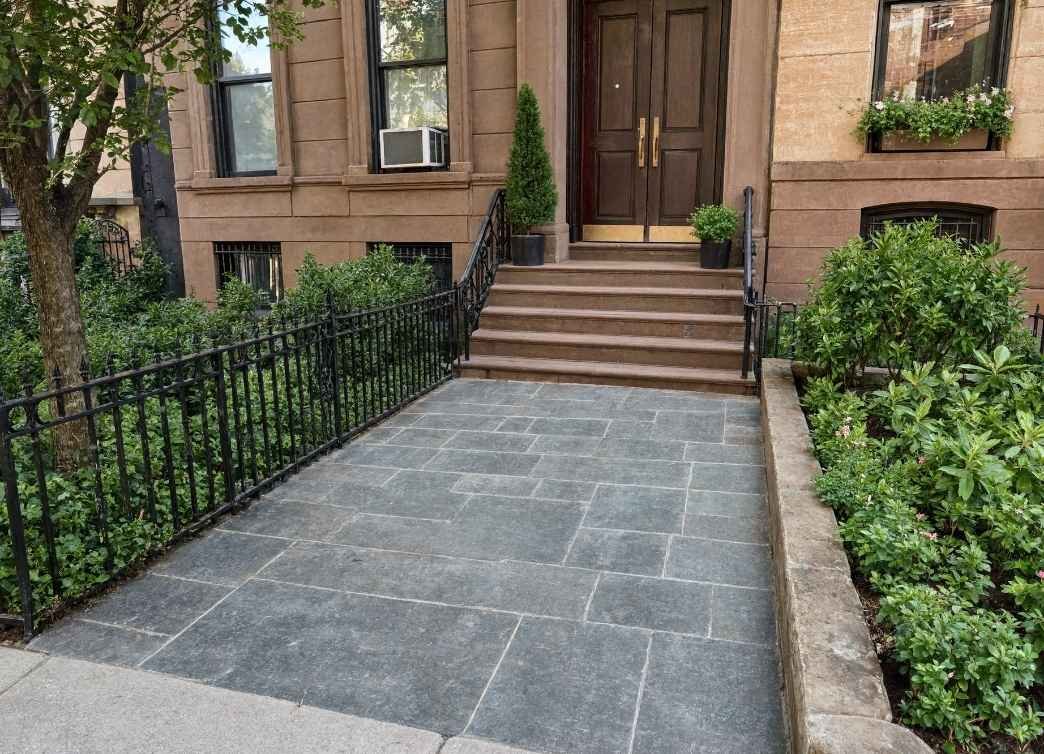
Stamped concrete is allowed on your private front walkway with no city approval needed at all, but on the actual public sidewalk, it's treated as a "non-standard" material that requires a Distinctive Sidewalk Maintenance Agreement with NYC DOT plus Public Design Commission approval, unless your property sits in one of the specific commercial zoning districts where pigmented concrete is already the mandated standard.
That one distinction, walkway versus sidewalk, is the difference between a stamped concrete walkway you can install this month and a stamped concrete sidewalk NYC project that needs city sign-off first. Here's exactly where that line falls and what each path actually involves.
Sidewalk vs. Walkway: Why NYC Treats Them Differently
The sidewalk is technically city property. Even though you're responsible for maintaining it, your front walkway is not. The "sidewalk" in DOT's eyes is the paved strip running between the curb and your property line. Legally, it's part of the public right-of-way, which is exactly why the city gets a say in what materials go down. Your front walkway, on the other hand, the path that runs from your stoop or driveway to that sidewalk, sits entirely on private property. DOT has no jurisdiction there.
This one line is why so many homeowners get confused searching for stamped concrete sidewalk ideas online and end up disappointed. National design blogs are photographing private walkways. NYC's rules are written for the public sidewalk, and property owners are on the hook for maintaining that public strip under Section 19-152 of the NYC Administrative Code, with potential liability for injuries under Section 7-210 if it's left in disrepair. Keep the sidewalk and the walkway separate in your head, and the rest of this gets a lot simpler.
Is Stamped Concrete Allowed on NYC Sidewalks?
Outside a specific set of commercial corridors, plain, untinted gray concrete scored in DOT's standard 5-foot by 5-foot pattern is still the default, and anything else, including stamped, pigmented, or decorative concrete sidewalks, is classified as "non-standard" or "distinctive" material. Under Section 2-09 of the city's Highway Rules (Title 34 RCNY), any sidewalk finish other than standard concrete counts as distinctive. That includes brick, bluestone, exposed aggregate, and yes, stamped or decorative concrete sidewalks. The Public Design Commission's own guidelines confirm this directly, noting that anything deviating from standard gray concrete with simulated saw-cut joints is treated as distinctive unless historic paving already exists on the block.
Choosing one of these isn't off the table, but it isn't a simple permit either. You'd need to file for a Distinctive Sidewalk Maintenance Agreement with NYC DOT and get sign-off from the Public Design Commission before a contractor can pour anything, a submission that's filed by DOT for an existing building or by the Department of Buildings if the sidewalk is part of new construction. That process exists because the city wants uniformity and durability across the public walking surface, a stamped finish that looks great on day one but wears unevenly under foot traffic, delivery carts, and winter salt, which becomes a tripping hazard the city then has to police.
Where Decorative Concrete Sidewalks Are Actually Required
In a handful of Manhattan's busiest commercial districts, pigmented concrete isn't just allowed, but it's the mandatory standard. Per NYC DOT's Commercial District Pigmented Concrete Sidewalk Standards, properties in C4-4 through C4-7, C5, and C6 commercial zoning districts, including parts of the Special Midtown District, are required to use pigmented concrete with saw-cut joints once a sidewalk replacement covers 50% or more of the frontage in front of a lot. This is the tinted, tan-toned sidewalk pattern you've probably noticed along stretches of Fifth Avenue or the Flatiron District. It's not a design choice, but it's zoning.
If your property falls in one of these districts, you're actually in a simpler position than most: PDC approval isn't required for pigmented concrete here, since it's the prescribed standard. Existing sidewalks don't have to be torn out to meet it either; the requirement only kicks in once you're replacing half the frontage or more. One important carve-out worth flagging early: DOT is explicit that this pigmented concrete standard does not apply inside landmarked historic districts, which run under a completely separate set of rules covered below. Everywhere else in the city, decorative concrete sidewalks stay in the "special approval" category.
Stamped Concrete Walkway Ideas That Actually Work for NYC Homes
Your private front walkway is where the creative freedom really opens up, since it isn't governed by DOT or PDC at all. This is the space where a stamped concrete walkway can do a lot for curb appeal without a single extra filing. A few patterns and finishes that read well against NYC's brownstone, rowhouse, and brick-front housing stock:
-
Ashlar slate pattern in a charcoal or slate-gray tone, which mimics natural stone without the cost or the maintenance of individual pavers.
-
Running-bond or herringbone brick stamps, especially nice alongside a brick or brownstone façade where you want the walkway to feel original to the house.
-
Cobblestone texture in a warm tan or sandstone tint for a Brooklyn Heights or Carroll Gardens–style approach to the front door.
-
Border accents a plain concrete field with a stamped or scored border in a contrasting shade, which keeps costs down while still upgrading the look.
-
Color-hardened finishes in earth tones that hide salt residue and tire marks better than plain gray, a real advantage during NYC winters.
If you're comparing concrete sidewalk ideas for the public strip against walkway ideas for your own property, this is usually where the actual transformation happens for most homeowners, no agreements, no commission review, just a design decision and a qualified installer. A well-designed stamped concrete front walkway is often the single upgrade that changes how the whole property reads from the street, especially on rowhouses where the entry path is the first thing anyone notices. Whether you're set on a decorative concrete walkway with a stone-look stamp or something simpler with a scored border, our team handles concrete walkway installations across the boroughs and can walk you through pattern, color, and sealant options that hold up to NYC weather.
Stamped Concrete in Historic Districts: What Changes
If your home sits inside a designated historic district, decorative concrete gets more complicated, sometimes even on your private walkway, and almost always on the sidewalk itself. The Landmarks Preservation Commission regulates sidewalk paving under Section 2-19 of its rules (Title 63 RCNY) in areas like Brooklyn Heights, Fort Greene, Boerum Hill, Park Slope, and dozens of other historic districts where bluestone, granite, or brick paving is considered a defining architectural feature. LPC actually maintains two categories of historic district: those with "regulated" sidewalk material, where enough original bluestone, granite, or brick survives that it must be preserved, and those with "non-regulated" sidewalk material, where DOT's standard pigmented concrete rules apply instead. In regulated districts, existing bluestone flags generally have to be preserved and reset. The NYC Street Design Manual specifies a minimum 2.25-inch-thick bluestone standard for any replacement pieces, rather than replaced outright with stamped concrete, and any new concrete paving typically needs to be tinted to visually match the historic material next to it.
A stamped concrete sidewalk pattern that would be a routine approval in most of the city can require full LPC review here, and applications for purely decorative finishes are often discouraged if the block still has intact historic paving. If your property is in one of these neighborhoods, it's worth checking your district's status before you fall in love with a specific look. Our sidewalk repair Brooklyn crew works inside these historic districts regularly and can tell you early on whether your block is subject to LPC review before you spend time designing something that won't clear it.
How to Get a Decorative or Stamped Sidewalk Approved
Getting a stamped, pigmented, or otherwise decorative sidewalk approved in NYC means going through DOT and, in most cases, the Public Design Commission, not just pulling a standard sidewalk permit. The general path looks like this:
-
Confirm your zoning district. If you're in C4-4 through C4-7, C5, or C6, pigmented concrete is already the standard, and the process is far simpler. You can search NYC's zoning maps by address to check.
-
Check for historic district status. If yes, LPC review under Title 63 §2-19 comes first, and material choices are more restricted.
-
File for a Distinctive Sidewalk Maintenance Agreement with DOT. Submitted through DOT for an existing sidewalk or through the Department of Buildings for new construction if your property is outside those commercial zones and you still want a decorative or stamped finish.
-
Submit for Public Design Commission approval, which reviews the design for its aesthetic impact on the streetscape as well as durability and safety.
-
Pull your standard DOT sidewalk construction permit once the material is approved, currently $70 per 300 linear feet of sidewalk, and hire a qualified contractor familiar with NYC's specification requirements for thickness, scoring, and expansion joints.
Skipping any of these steps is how homeowners end up with a beautiful sidewalk that also becomes a violation. If you're planning a full sidewalk replacement and want someone who already knows this filing process end to end, our NYC sidewalk repair experts handle the permitting alongside the installation, so you're not the one chasing paperwork between DOT and PDC.
Is a Stamped Concrete Sidewalk Worth the Extra Steps?
For most homeowners, the honest answer is that the front walkway delivers most of the visual payoff without any of the approval process, while a stamped public sidewalk is worth pursuing mainly on commercial or high-visibility properties. Concrete sidewalk stamping does cost more upfront than plain gray, typically due to the sealing and coloring process, and it needs resealing every couple of years to keep its texture and tone from fading under NYC's freeze-thaw winters and de-icing salt. On a private walkway, that maintenance is entirely your call. On the public sidewalk, DOT's approval process exists precisely because they don't want a decorative finish deteriorating into an uneven, city-owned tripping hazard a few years down the line.
Get Expert Help With Your NYC Sidewalk or Walkway Project
Between DOT specifications, PDC approvals, and LPC historic district rules, figuring out what you're actually allowed to build can take longer than the installation itself. That’s where The Sidewalk Repair NYC steps in. Our licensed and insured contractors work across all five boroughs, handling everything from standard sidewalk replacements to decorative walkway installations and historic district filings, so you get a finish that looks the way you pictured it and passes inspection the first time. Reach out to The Sidewalk Repair NYC for a free consultation along with a free estimate for your project.